

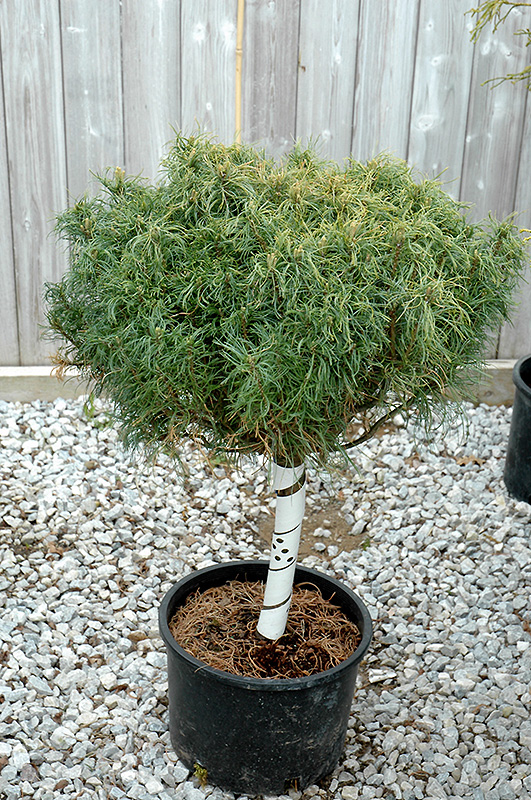
Kurly Top White Pine (tree form) Pinus strobus 'Kurly Top (tree form)' Height: 4 feet Spread: 3 feet
Sunlight:
Hardiness Zone: 4a Other Names: Eastern White Pine Description: An interesting small tree form featuring curly, twisted blue-green needles; compact and slow growing, excellent for form, texture and color detail in home gardens or for rock gardens; needs full sun Ornamental Features Kurly Top White Pine (tree form) is primarily valued in the landscape or garden for its highly ornamental lollipop-like shape. It has attractive blue-variegated bluish-green foliage. The twisted needles are highly ornamental and remain bluish-green throughout the winter. Landscape Attributes Kurly Top White Pine (tree form) is a dense evergreen dwarf tree, selected and trained to grow in a small tree-like form with the primary plant grafted high atop a standard. Its relatively fine texture sets it apart from other landscape plants with less refined foliage. This dwarf tree will require occasional maintenance and upkeep. When pruning is necessary, it is recommended to only trim back the new growth of the current season, other than to remove any dieback. Gardeners should be aware of the following characteristic(s) that may warrant special consideration; Kurly Top White Pine (tree form) is ideal for use as a garden accent or patio feature, and is recommended for the following landscape applications; Planting & Growing Kurly Top White Pine (tree form) will grow to be about 4 feet tall at maturity, with a spread of 3 feet. It tends to be a little leggy, with a typical clearance of 2 feet from the ground. It grows at a slow rate, and under ideal conditions can be expected to live for 50 years or more. This dwarf tree should only be grown in full sunlight. It is very adaptable to both dry and moist growing conditions, but will not tolerate any standing water. It is not particular as to soil type, but has a definite preference for acidic soils, and is subject to chlorosis (yellowing) of the foliage in alkaline soils. It is quite intolerant of urban pollution, therefore inner city or urban streetside plantings are best avoided, and will benefit from being planted in a relatively sheltered location. This is a selection of a native North American species.







By
Ben Richard
/ January 8, 2025

Characteristics
Applications
Features & Attributes