

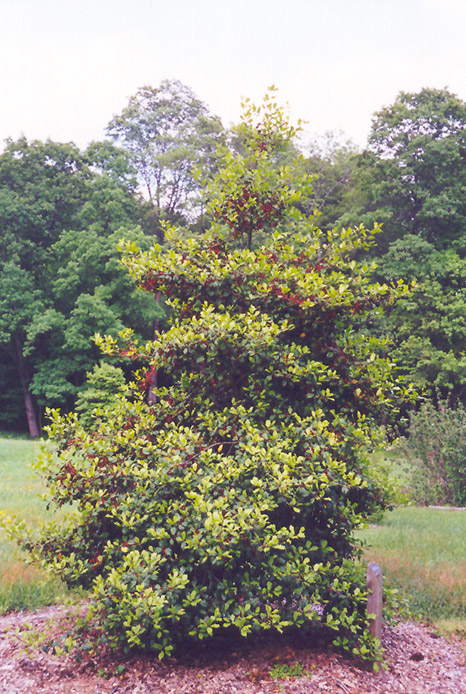
McDonald American Holly Ilex opaca 'McDonald' Height: 35 feet Spread: 20 feet
Sunlight:
Hardiness Zone: 4b Description: Showy red berries persist through the winter and attracts birds; spiny, dark green leaves; nice pyramidal shape; does best in evenly moist, acidic soil Ornamental Features McDonald American Holly is primarily grown for its highly ornamental fruit. It features an abundance of magnificent red berries from early fall to late winter. It has attractive dark green evergreen foliage which emerges light green in spring. The spiny oval leaves are highly ornamental and remain dark green throughout the winter. Landscape Attributes McDonald American Holly is a dense evergreen tree with a strong central leader and a distinctive and refined pyramidal form. Its average texture blends into the landscape, but can be balanced by one or two finer or coarser trees or shrubs for an effective composition. This tree will require occasional maintenance and upkeep, and is best pruned in late winter once the threat of extreme cold has passed. It is a good choice for attracting birds and bees to your yard. It has no significant negative characteristics. McDonald American Holly is recommended for the following landscape applications; Planting & Growing McDonald American Holly will grow to be about 35 feet tall at maturity, with a spread of 20 feet. It has a low canopy with a typical clearance of 3 feet from the ground, and should not be planted underneath power lines. It grows at a slow rate, and under ideal conditions can be expected to live for 60 years or more. This is a dioecious species, meaning that individual plants are either male or female. Only the females will produce fruit, and a male variety of the same species is required nearby as a pollinator. This tree does best in full sun to partial shade. It requires an evenly moist well-drained soil for optimal growth. It is very fussy about its soil conditions and must have rich, acidic soils to ensure success, and is subject to chlorosis (yellowing) of the foliage in alkaline soils. It is somewhat tolerant of urban pollution, and will benefit from being planted in a relatively sheltered location. Consider applying a thick mulch around the root zone in winter to protect it in exposed locations or colder microclimates. This is a selection of a native North American species.











By
Ben Richard
/ January 8, 2025

Characteristics
Applications
Features & Attributes